
PART I: THE ACADEMIC PROGRAM
USMA EDUCATIONAL PHILOSOPHY
USMA Mission:
To build, educate, train, and inspire the Corps of Cadets to be commissioned leaders of character committed to the Army Values and ready for a lifetime of service to the Army and Nation.
WPLDS: The West Point Leader Development System (WPLDS) is a comprehensive and integrated approach designed to harness every facet of the West Point experience while leveraging specific developmental events and activities to reinforce and assess character and honorable living. Upon commissioning, West Point graduates:
- Live honorably:
- Internalize the Cadet Honor Code, West Point Motto, and Army Values.
- Demonstrate moral courage regardless of personal consequences.
- Treat others with dignity and respect.
- Act with humility and professional decorum in all environments through appearance, demeanor, behaviors, and words.
- Lead honorably:
- Accomplish the mission consistent with the Army values.
- Know, adhere to, and enforce standards.
- Build cohesive and effective teams.
- Demonstrate excellence:
- Maximize academic, military, and physical performance.
- Seek challenges and feedback; reflect and improve.
- Communicate and interact effectively.
- Anticipate and solve complex problems.
ACADEMIC PROGRAM GOALS
In support of WPLDS, the Academic Program has established the following overarching goal and seven Academic Program Goals (APGs) to help guide the academic development of cadets. Each of the seven goals is accompanied by supporting objectives called “What Graduates Can Do” (WGCD) statements. WGCD statements define specific indicators of skills expected of cadets at the time of graduation and are the assessable objectives that we use to determine if our core and major programs are achieving the standards of our program goals as expected. Each is listed below their respective APG in the following list. Our APGs also directly reflect upon, connect with, and contribute to achievement of the institutional outcomes defined within WPLDS.
Academic Program Goals:
- Graduates think critically and creatively.
- WGCD 1.1: Identify the essential aspects of a situation and develop relevant inquiries.
- WGCD 1.2: Gather, evaluate, and synthesize information from diverse sources.
- WGCD 1.3: Develop innovative ideas and envision possibilities using knowledge and skills from a variety of disciplines.
- WGCD 1.4: Employ quantitative and qualitative approaches to analyze problems and inform decisions.
- WGCD 1.5: Develop, assess, and refine solutions while taking into account uncertainty and risk.
- WGCD 1.6: Reflect and apply lessons learned to inform decision-making and continuous improvement.
- Graduates reason and act ethically.
- WGCD 2.1: Explain the foundations and principles of values-based reasoning.
- WGCD 2.2: Identify the moral dimensions of problems and situations.
- WGCD 2.3: Apply ethical principles to leadership and professional responsibilities.
- Graduates communicate effectively.
- WGCD 3.1: Listen actively and read critically to understand meaning, intent, and context.
- WGCD 3.2: Speak and write professionally and effectively in Standard American English.
- WGCD 3.3: Effectively convey information to a wide variety of audiences using appropriate forms and media.
- WGCD 3.4: Construct and evaluate arguments using sound reasoning and evidence.
- WGCD 3.5: Communicate effectively within and across cultural and linguistic boundaries.
- WGCD 3.6: Communicate effectively within and across disciplines and professional contexts.
- Graduates apply science, technology, engineering, and mathematics to solve complex problems.
- WGCD 4.1: Apply mathematics, science, and computing to analyze and model devices, systems, processes, or behaviors.
- WGCD 4.2: Apply the scientific method.
- WGCD 4.3: Collect, analyze, and interpret data to inform evidence-based conclusions and evaluate outcomes.
- WGCD 4.4: Apply an engineering design process to create effective and adaptable solutions.
- WGCD 4.5: Demonstrate effective teaming with computing tools.
- Graduates apply the humanities and social sciences to contextualize and engage complex challenges.
- WGCD 5.1: Recognize, analyze, and know how to influence human behavior.
- WGCD 5.2: Analyze cultures, histories, and narratives to understand varied perspectives.
- WGCD 5.3: Analyze political, legal, military, and economic influences on social systems.
- WGCD 5.4: Engage effectively in cross-cultural contexts and reflect on those experiences.
- WGCD 5.5: Apply humanities and social science methods and frameworks to inform decisions and actions.
- Graduates apply in-depth knowledge and methods from an academic discipline.
- WGCD 6.1: Recognize the applications and limitations of an academic discipline.
- WGCD 6.2: Apply evolving disciplinary tools, methods of inquiry, and theoretical approaches to address contemporary academic and professional challenges.
- WGCD 6.3: Synthesize knowledge and concepts within and across disciplines.
- Graduates are lifelong learners.
- WGCD 7.1: Pursue knowledge independently.
- WGCD 7.2: Learn and work collaboratively.
- WGCD 7.3: Reflect on experiences, seek feedback, and adapt to support continuous intellectual growth.
ACCREDITATION
The United States Military Academy is accredited by the Middle States Commission on Higher Education, 1007 North Orange Street, 4th Floor, MB #166, Wilmington, DE 19801 (267-284-5011). The Middle States Commission on Higher Education is an institutional accrediting agency recognized by the U.S. Secretary of Education.
The following programs at the United States Military Academy are accredited by ABET:
- EAC Programs
- The Bachelor of Science (B.S.) in Chemical Engineering at the United States Military Academy is accredited by the Engineering Accreditation Commission of ABET under the commission’s General Criteria and Program Criteria for Chemical Engineering and similarly named engineering programs.
- The Bachelor of Science (B.S.) in Civil Engineering at the United States Military Academy is accredited by the Engineering Accreditation Commission of ABET under the commission’s General Criteria and Program Criteria for Civil Engineering and similarly named engineering programs.
- The Bachelor of Science (B.S.) in Electrical Engineering at the United States Military Academy is accredited by the Engineering Accreditation Commission of ABET under the commission’s General Criteria and Program Criteria for Electrical Engineering and similarly named engineering programs.
- The Bachelor of Science (B.S.) in Engineering Management at the United States Military Academy is accredited by the Engineering Accreditation Commission of ABET under the commission’s General Criteria and Program Criteria for Engineering Management and similarly named engineering programs.
- The Bachelor of Science (B.S.) in Environmental Engineering at the United States Military Academy is accredited by the Engineering Accreditation Commission of ABET under the commission’s General Criteria and Program Criteria for Environmental Engineering and similarly named engineering programs.
- The Bachelor of Science (B.S.) in Mechanical Engineering at the United States Military Academy is accredited by the Engineering Accreditation Commission of ABET under the commission’s General Criteria and Program Criteria for Mechanical Engineering and similarly named engineering programs.
- The Bachelor of Science (B.S.) in Nuclear Engineering at the United States Military Academy is accredited by the Engineering Accreditation Commission of ABET under the commission’s General Criteria and Program Criteria for Nuclear Engineering and similarly named engineering programs.
- The Bachelor of Science (B.S.) in Systems Engineering at the United States Military Academy is accredited by the Engineering Accreditation Commission of ABET under the commission’s General Criteria and Program Criteria for Systems Engineering and similarly named engineering programs.
- CAC Programs
- The Bachelor of Science (B.S.) in Computer Science at the United States Military Academy is accredited by the Computing Accreditation Commission of ABET under the commission’s General Criteria and Program Criteria for Computer Science and similarly named programs.
- The Bachelor of Science (B.S.) in Cyber Science at the United States Military Academy is accredited by the Computing Accreditation Commission of ABET under the commission’s General Criteria and Program Criteria for Cybersecurity and similarly named programs.
- ANSAC Program
- The Bachelor of Science (B.S.) in Applied Statistics and Data Science at the United States Military Academy is accredited by the Applied and Natural Science Accreditation Commission of ABET under the commission’s General Criteria and Program Criteria for Data Science and similarly named programs.
- The Geospatial Science Major is accredited by the United States Geospatial Intelligence Foundation (USGIF).
- The Chemistry Major with ACS Certification track is approved by the Committee on Professional Training of the American Chemical Society (ACS).
THE ACADEMIC PROGRAM
The Academic Program is responsible for the intellectual development of cadets. Led by a Brigadier General, the Dean of the Academic Board, the Academic Program consists of courses, majors, minors, and enrichment activities across thirteen academic departments.
GRADUATION REQUIREMENTS AND ACADEMIC STANDARDS
Army Regulation 150-1, United States Military Academy Organization, Administration and Operation states that First Class cadets who have successfully completed the requirements of the course of instruction, including academic, military, and physical development programs; have maintained prescribed standards of conduct; and who have demonstrated proper moral-ethical qualities, leadership, and character may receive a diploma signed by the Superintendent, USMA, the Commandant of Cadets, and the Dean of the Academic Board. These cadets will have earned the Bachelor of Science degree and will be designated graduates of USMA. Graduation requirements for all three programs — academic, military, and physical — and institutional (non-program) requirements by class year are available through the following link: Classes of 2024-2026, Classes of 2024-2026 Addendum, Class of 2027, Class of 2028, Class of 2029, and Class of 2030.
ACADEMIC GRADUATION REQUIREMENTS
To satisfy the academic portion of these graduation requirements, a cadet must:
- Successfully complete or validate each course in the core curriculum, including the common core courses and a core engineering sequence
- Satisfy the requirements of at least one major
- Successfully complete 40 academic courses of at least 3.0 credit hours each. Validated and remedial courses cannot count towards this requirement.
- Achieve a 2.00 Cumulative Quality Point Average (CQPA). The CQPA is calculated based on letter-grade performance for any academic, physical, or military course with credit hours. The CQPA generally corresponds to grade point average (GPA) in other colleges and universities.
As part of the West Point experience, a cadet is required to complete requirements and achieve minimum standards in three developmental programs within the USMA West Point Leader Development System (WPLDS). Within the WPLDS, the military program score (MPS), the physical program score (PPS), and the academic program score (APS) combine to form the cadet performance score (CPS). The score is calculated by first normalizing each program score to a mean zero and standard deviation of one and then calculating a weighted average based on a cadet’s three normalized scores. A complete explanation of the calculation of the CPS, which ultimately determines a cadet’s class rank, can be found at this link (CPS Calculation). The APS is based on performance in courses within the Academic Program and does not include military science and physical education courses. Refer to DPOM 02-01 for APS computation details. Cadets who are deficient in one or more of the three developmental programs for failure to maintain minimum program performance standards may be considered by the Academic Board for separation.
The United States Military Academy’s academic curriculum has two significant structural features. The first is a core of twenty-four academic courses that the Academy considers essential to the broad base of knowledge necessary for all graduates and a three-course core engineering sequence for those cadets who do not choose to major in engineering. This core academic curriculum, when combined with physical education and military science, provides USMA cadets with the necessary knowledge, skills, and attributes necessary for future officers in the U.S. Army. The second structural feature is the opportunity to specialize and explore an area in depth through the selection of an academic major consisting of not less than thirteen required or elective courses.
WHAT CONSTITUTES A COURSE
Although ‘course’ is a commonly used word in curriculum descriptions, USMA has the following requirements for an educational experience to be termed a ‘course.’ Each course is different in many specific ways. In general, however, there are guidelines for any course of instruction which contribute to its being worthy of academic credit. The development of a course along the following lines is what is required for a course to be included for academic credit on a cadet’s academic transcript.
Course outcomes that require new learning experiences. Learning involves a change in capabilities or dispositions that can be attributed to experience. “Change” usually implies students acquiring a new capability or disposition: what they know (knowledge), how they use what they know (intellectual skills), how they think, what they can do (physical skills), or what they value (attitudes and values). Learning is not normally considered as maintenance of already acquired capabilities. A course of instruction then is the purposeful arrangement of experiences designed to facilitate intended change in students’ capabilities or dispositions which we represent by course outcomes.
A valid, comprehensive method of evaluating student mastery of course outcomes. Student evaluation is a critical component of the learning process and must be present in a course of instruction. We recognize that evaluation methods and the frequency of evaluation will vary as a function of course outcomes; however, the evaluation method should assess students’ mastery of course outcomes and should permit valid inferences about student learning.
If a course of instruction meets the preceding two guidelines, then the awarding of credit hours should be based on a calculation of planned time (40 hours of planned time associated with 1.0 credit hour). A 3.0 credit hour course usually requires 40 instructor contact hours with two hours of preparation required for each hour in class: 40 lessons at 3hrs/lesson (1 contact hour in-class and 2 hours of outside preparation) = 120 hours = 3.0 credit hours; 30 lessons at 4hrs/lesson (1.25 contact hours in-class and 2.75 hours of outside preparation) = 120 hours = 3.0 credit hours.
ACADEMIC COURSE LOADS
The minimum load that all cadets must carry under normal circumstances is five academic courses which are equal to or greater than 15 semester hours of credit. Fourth Class cadets may take four academic courses in the semester when they have MS100 and PE215. In addition, cadets will meet established requirements for physical education courses and military science core curriculum during a regular academic semester.
During the summer, the Military Academy provides opportunities to pursue Academic Individual Advanced Development (AIAD) and to complete coursework in the Summer Term Academic Plan (STAP). Under some circumstances, STAP may be used to reduce a course load during the academic year to four courses for a term.
OVERLOADING
Cadets are considered overloading when they are carrying seven academic courses in a term. Overload courses offer the means of adapting an academic program to capitalize upon a cadet’s abilities and to satisfy a particular interest. During the Third, Second, and First Class years, cadets may wish to enroll in one overload course for each term. Approval will depend upon demonstrated ability and motivation. Specifically, Dean’s List recognition in the preceding term is required. Cadets with a Cumulative Quality Point Average (CQPA) of 2.30 or higher may overload in their First Class year. The designated overload course must be a course that can be dropped without jeopardizing any academic graduation requirements (e.g., core courses, primary major courses).
Cadets are required to designate which of their courses is the designated overload course. No change in this designation will be permitted after the term begins. A cadet who enrolls in an overload course and finds the course unsuited to his or her needs may request withdrawal from the overload course through the Academic Affairs and Registrar Services (AARS), Office of the Dean, any time after the first month of the term and up until the beginning of Term End Examinations (TEE). The Dean may remove a cadet from an overload course for poor performance in that course or in any other course.
VALIDATION AND ADVANCED COURSE ENROLLMENT
Advanced Placement test scores and previous high school or college academic records are reviewed by the academic departments to determine whether a cadet is eligible for validation of certain courses. Many academic departments use examinations and personal interviews, in addition to screening academic records, to assist in their evaluation. When the process is completed, a cadet may be offered the opportunity to validate a course. The cadet can choose to accept the course validation, understanding that they may have to replace the validated course with another course, or the cadet can decline the validation and choose to take the course. The significant aspects of validation are that it is voluntary, and that, while it excuses a cadet from taking a course, it does not reduce graduation course requirements. Validated courses will be reflected without credit hours on the transcript. However, the credit hour content of validated courses is recognized as contributing appropriate disciplinary content towards meeting programmatic rigor for accreditation purposes.
OVERVIEW OF THE ACADEMIC CURRICULUM
The two charts below further highlight an overview of the academic program. The first chart, figure 1, presents the curriculum in overall blocks of course requirements. The second chart, figure 2, presents the typical sequence of courses taken over eight semesters during a cadet’s 47-month experience.
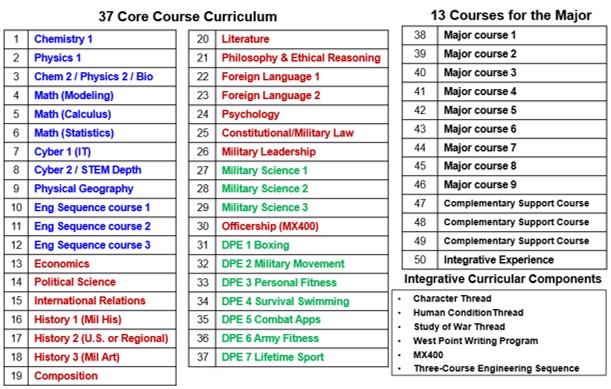
Courses in blue are Math, Science and Engineering (MSE) courses. Courses in red are Humanities and Social Science (HSS) courses. Courses in black are courses affiliated with each academic major. Courses in green are credit bearing courses from the Military and Physical Programs. Integrative Curricular Components are described below.
Fig 1a: Overview of the Academic Program (with additional MS and PE courses) – Class of 2023-2028
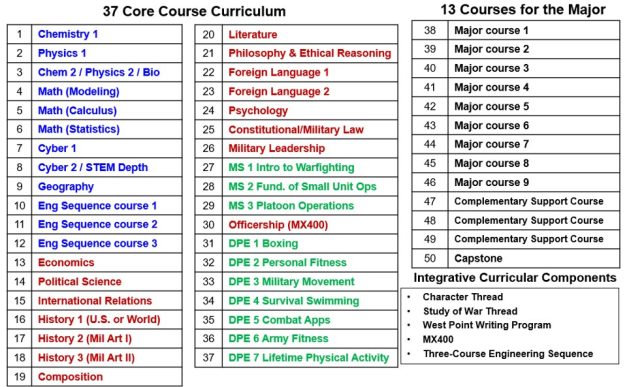
Courses in blue are Math, Science and Engineering (MSE) courses. Courses in red are Humanities and Social Science (HSS) courses. Courses in black are courses affiliated with each academic major. Courses in green are credit bearing courses from the Military and Physical Programs. Integrative Curricular Components are described below.
Fig 1b: Overview of the Academic Program (with additional MS and PE courses) – Class of 2029 and beyond
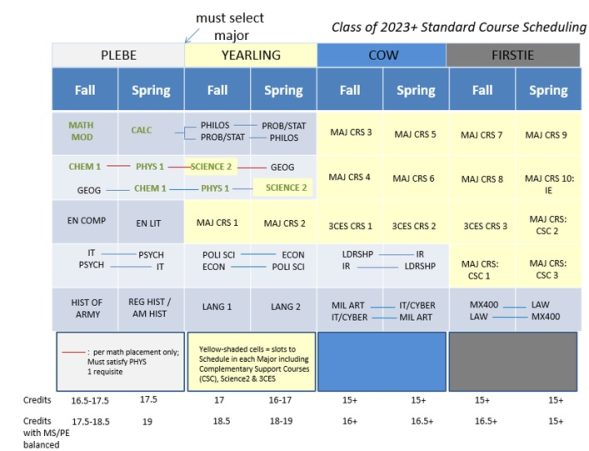
Fig 2a: Typical Sequence of Courses – 8 Term Academic Program (8TAP) – Class of 2023-2028
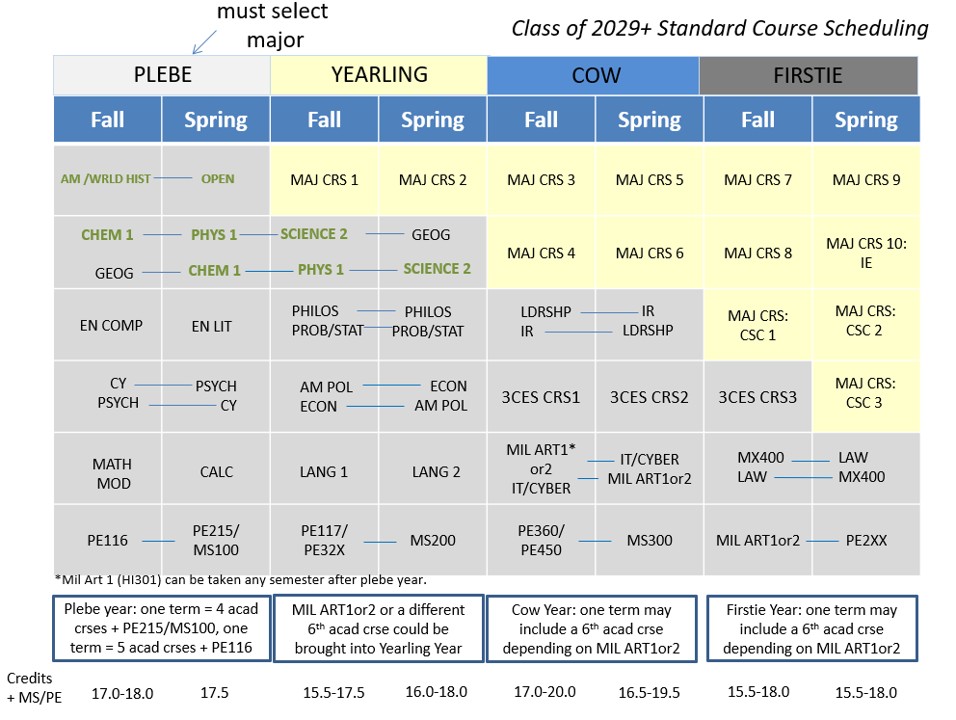
Fig 2b: Typical Sequence of Courses – 8 Term Academic Program (8TAP) – Class of 2029 and beyond
ACADEMIC CORE CURRICULUM
The foundation of the academic program at USMA is 24 core courses and three courses in an engineering sequence for those cadets who do not choose a major in engineering. For most cadets the first year is a common academic experience including, in term 2, the selection of a major, followed by the selection of a three-course engineering sequence in the Fall of Third Class year.
| Area | Required Courses | Alternate Courses (based on placement testing and validations) |
|---|---|---|
| Chemistry | CH101 General Chemistry I | CH151 Advanced General Chemistry |
| Artificial Intelligence/Cybersecurity I | AI105 Computing Fundamentals | AI155 Explorations in Computing Fundamentals |
| Economics | SS201 Economics, Principles and Problems | |
| English | EN101 Composition | EN151 Advanced Composition |
| Foreign Language | Two courses required. Sequence determined by the Department of English and World Languages based on cadet preferences, language ability, and available resources. | |
| History |
HI105 History of the United States OR HI108W Foundations of the Modern World |
HI155 Advanced History of the U.S. OR HI158W Advanced Foundations of the Modern World |
| International Relations | SS307 International Relations | SS357 Advanced International Relations |
| Law | LW403 Constitutional and Military Law | |
| Leadership |
PL100 General Psychology for Leaders AND PL300 Military Leadership |
PL150 Advanced General Psychology for Leaders AND PL350 Advanced Military Leadership |
| Literature | EN102 Literature | EN152 Advanced Literature |
| Mathematics |
MA103 Data-Driven Modeling AND MA104 Calculus AND MA206 Probability and Statistics |
MA153 Mathematical Modeling and Introduction to Differential Equations AND MA204 Calculus I & II (validates MA104) MA205 Calculus II (validates MA104) MA255 Advanced Multivariable Calculus (validates MA104) AND MA256 Advanced Probability and Statistics |
| Military History |
HI301 History of the Military Art to 1900 AND HI302 History of the Military Art from 1900 to Present |
HI351 Advanced History of the Military Art to 1900 AND HI352 Advanced History of the Military Art 1900 to Present |
| Officership | MX400 Officership | |
| Philosophy | PY201 Philosophy and Ethical Reasoning | PY251 Advanced Philosophy and Ethical Reasoning |
| Physical Geography | EV203 Physical Geography | |
| Physics | PH201 Physics I | PH251 Advanced Physics I |
| Political Science | SS202 American Politics | SS252 Advanced American Politics |
| Science Depth (choose one based on major and interest) |
CH102 General Chemistry II CH275 Biology PH202 Physics II PH275 Physics II, Space |
CH152 Advanced General Chemistry II CH375 Advanced Biology PH252 Advanced Physics II |
| Artificial Intelligence/Cyber Operations II |
CY305 Cyber Foundations |
CY355 Cyber Foundations, Computing EE301 Fundamentals of Electrical Engineering EE302 Introduction to Electrical Engineering |
Fig. 3. The 24 Core Academic Courses (and Alternates) by Discipline
Designed to provide educational breadth, the 24 academic core courses are listed above along with alternate sequences or courses. Cadets may be enrolled in authorized alternative courses to the academic core curriculum based on placement testing and/or validations. Alternative courses are usually more advanced versions of the basic core courses.
Mathematics, Science, and Engineering (MSE)
Within the core academic curriculum, there is a strong emphasis on mathematics, science, and engineering. The MSE sequence provides cadets with a fundamental knowledge of the experimental and analytic techniques of the basic sciences to strengthen their capacity to evaluate evidence, reason under certainty, inform decisions in complex environments, and communicate their findings effectively to both technical and non-technical audiences. This sequence begins in the Fourth Class year with two semesters of mathematics, one semester of chemistry, one semester of geography, and one semester of calculus-based physics. Geography or physics may be delayed until the Third Class year depending on faculty resources and cadet preferences. The coursework continues in the Third Class year with one semester of statistics and an additional science depth course that cadets select based on their major and their interests. The required science depth course provides cadets with additional study in a scientific discipline and reinforces their ability to apply the scientific method to real-world and Army-relevant problems. These courses include a laboratory component that develops proficiency in experiment design, data collection, analysis, interpretation, and communication.
ARTIFICIAL INTELLIGENCE/Cyber (AI/CYBER)
The core curriculum includes an artificial intelligence/cyber sequence (AI/CYBER) designed to ensure that every academy graduate is effective in teaming with computing tools, enabling data-driven decision making, and securely operating the contested cyber domain as an Army officer. AI/CYBER skills are first developed through an introductory computing course in the Fourth Class year, which prepares cadets to team with AI to solve problems throughout the curriculum. This is followed by a course taken during Second or First Class year that further develops confidence and experience to engage with emerging technologies applied to military applications and pervasive warfighting themes, including an adversarial mindset and innovation cycles.
Foreign Language
Most cadets will begin their study of a foreign language in Third Class year. If a cadet expresses an interest, however, the sequence may be started in Fourth Class year (contingent on seat availability and discretion of the Registrar). All cadets will take at least two semesters of one of the eight foreign languages offered in residence. Course work will present perspectives from another culture, develop the ability to learn another language, provide an introductory level of proficiency in the language selected, and provide a firm foundation for further language study.
These features mean that the first two academic semesters are a common core experience for the majority of cadets, and most of the second two semesters are common as well. Individual alterations to the typical sequence can be made based on specific needs and capabilities. Cadets are encouraged to work closely with academic counselors when designing their academic programs.
CORE ENGINEERING SEQUENCES (CES)
Cadets will seek counsel from their Department Academic Counselors (DACs) in the beginning of their Third Class year to request a CES that complements their academic major and interests. The Registrar will fill CES enrollments based on cadet preferences and faculty availability. CES assignments typically cannot be changed after the initial assignment unless the cadet finds a cadet ‘trade partner’ in the same year group who is willing to make a swap.
AI – Artificial Intelligence and Data Engineering
- AI300 Programming Fundamentals
- AI350 Data Engineering
- AI450 Engineering AI
The Artificial Intelligence and Data Engineering (AIDE) Core Engineering Sequence (CES) equips cadets with practical skills to tackle the challenges in the modern data-driven world. This sequence focuses on fundamental programming and data engineering skills and the development and application of artificial intelligence models that rely on engineered data. The first course, AI300 Programming Fundamentals, provides cadets with a broad introduction to computer programming, allowing them to design, build, and test small to medium programs that use various data sets. The second course, AI350 Data Engineering, teaches cadets the skills to retrieve, validate, transform, visualize, and extract insights from data in various formats. Building on the skills developed in AI300 and AI350, AI450 Engineering AI, empowers cadets to implement AI models that enhance decision-making and perform rapid prediction. The depth and practical applicability of the skills taught in AIDE start cadets down the path toward mastery of data engineering and AI. This curriculum will prepare cadets to lead and innovate in various industries, providing critical competitive advantages, including strategic superiority for institutions such as the US Military.
AM – Aero-Mechanical Engineering
- AM300 Introduction to Mechanical Engineering
- AM350 Thermal-Fluid Systems with Army Applications
- AM450 Mechanical Systems with Army Applications
The Aero-Mechanical Engineering Sequence focuses on the technologies that power, move, project, and sustain Army forces. Cadets develop an understanding of the mechanical and aerospace engineering principles behind military systems ranging from combat vehicles and aircraft to power generation, environmental control systems, robotics, thermal sensors, and advanced weapon systems. Throughout the sequence, cadets apply engineering design, critical thinking, and problem-solving skills to challenges relevant to future Army officers. The first course, AM300 Introduction to Mechanical Engineering, introduces the engineering design process and foundational engineering skills, including technical communication, computer-aided design, programming, and additive manufacturing. Working in teams, cadets design, prototype, and evaluate solutions to Soldier-centered challenges while learning how engineers transform ideas into practical systems. The second course, AM350 Thermal-Fluid Systems with Army Applications, explores thermodynamics, fluid mechanics, and heat transfer through Army-relevant applications. Cadets analyze systems such as aircraft and vehicle propulsion, power generation, environmental control systems, thermal management, and flight technologies while applying engineering principles to understand and improve system performance. The final course, AM450 Mechanical Systems with Army Applications, examines mechanics, dynamics, energy and power in military systems. Cadets investigate structures, mobility systems, robotics, power transmission, and emerging technologies while applying engineering analysis and design methods to solve complex operational problems. The sequence culminates in hands-on design experiences that integrate technical knowledge, creativity, teamwork, and decision-making. Cadets gain a practical understanding of the technologies that enable Army lethality, mobility, protection, and sustainment, preparing cadets to lead Soldiers and make informed decisions in increasingly technical operational environments.
CY – Cyber Engineering
- CY300 Programming Fundamentals
- CY350 Network Engineering and Management
- CY450 Cyber Security Engineering
The Cyber Engineering Sequence focuses on fundamental cyber-enabling skills as well as current cyber-related issues, threats, vulnerabilities, and non-technical considerations. As the newest warfighting domain and branch of the Army, cyberspace presents new opportunities and demands for leaders to protect and exploit networks and information resources. Cyber leaders must understand computer systems, networks, and information assurance and be able to analyze, design, and evaluate such systems. The Cyber Engineering Sequence is designed to provide sufficient breadth and depth of knowledge for non-technical majors to establish a nucleus for subsequent learning and adaptation to rapid change. The first course, CY300 Programming Fundamentals, provides cadets with broad introduction to computer programming, which will allow them to design, build, and test small to medium programs. The second course, CY350 Network Engineering and Management, addresses the analysis, design, building, and testing of modern computer networks. Cadets implement and test wired and wireless networks using standard network models, protocols, and practices. In the final course, CY450 Cyber Security Engineering, cadets learn principles of information system security and best practices, and apply techniques and tools to evaluate and improve network security. The capstone integrative experience requires cadets to employ offensive and defensive cyber measures and consider the economic, socio-cultural, and political considerations that impact the technological solutions.
EV – Environmental Engineering
- EV300 Environmental Science
- EV350 Environmental Engineering Technologies
- EV450 Environmental Engineering for Community Development
The Environmental Engineering Sequence focuses on environmental quality issues and designing viable, sustainable solutions to them. The sequence emphasizes the science and engineering commonly used to protect public health and the environment. The experience gained allows graduates to address multiple perspectives across relevant Army topics such as installation drinking water and wastewater infrastructure, energy, and environmental stewardship. The first course, EV300 Environmental Science, provides Cadets with a broad understanding of what the term “environmental quality” encompasses. Cadets analyze the influences, especially human, affecting Earth’s natural and biological cycles. CV300X Introduction to Sustainable Design is an acceptable substitute for EV300 and will completely supersede EV300 once fully approved by the Curriculum Committee. CV300X provides cadets with a philosophical basis to engineering design thinking. Cadets examine the ethical imperative for functioning, resilient infrastructure, inventory and price unintended residuals from infrastructure services, estimate life cycle costs of infrastructure, and are introduced to value-based decision making. The second course, EV350 Environmental Engineering Technologies, explores environmental engineering from a unit process and mass balance approach. Cadets solve fundamental problems in drinking water, wastewater, and air pollution that would be encountered in a high-income country. The final course, EV450 Environmental Engineering for Community Development, employs a semester-long design project to engineer solutions for a real-world case study in low- and middle-income countries. Cadets use a value-based decision-making model to consider the economic, socio-cultural, and political considerations that impact technological solutions.
IN – Infrastructure Engineering
- CE330 Fundamentals of Engineering Mechanics and Design
- CE350 Infrastructure Engineering
- CE450 Construction Management
The Infrastructure Engineering Sequence focuses on the design, analysis, and construction of the built environment (i.e., man-made structures and facilities used to accommodate societies’ activities). Cadets learn about the importance of the infrastructure sectors, such as water, power, and transportation, and their inter-relationships. The first course, CE330 Fundamentals of Engineering Mechanics and Design, provides cadets with foundational engineering mechanics as the basis for all structural elements in the context of learning the engineering design process. In the second course, CE350 Infrastructure Engineering, cadets learn to identify, analyze, and assess the built environment, which is the infrastructure foundation for modern society. Expanding upon the structural systems introduced in the first course, cadets engage in learning about water and wastewater, power, transportation, solid waste, communications systems, public administration, and sustainment. In the third course, CE450 Construction Management, cadets learn how to plan and execute construction of the built environment. The culminating event that brings together the two previous courses is the designing, planning, and presenting of a construction briefing of a base camp in a combat theater of operations. Integral to all three courses is an active learning environment with emphasis on classroom demonstrations, virtual and physical simulations, and practical exercises.
NE – Nuclear Engineering
- NE300 Fundamentals of Nuclear Engineering
- NE350 Radiological Engineering Design
- NE450 Nuclear Weapons Effects
The Nuclear Engineering Sequence studies the practical use of the energy that is released by the nucleus. Applications extend into the fields of power generation, medicine, nuclear weapons, and nuclear weapons effects. The sequence is designed to provide introductory knowledge in the applications of nuclear energy and what Army officers should know about nuclear reactors, radiation health physics, radiation detection, and nuclear weapons and weapons effects. The first course, NE300 Fundamentals of Nuclear Engineering, provides cadets with an understanding of the nuclear particles and interactions important to the fission process. Cadets learn about radioactivity, the interactions of radiation with matter, and how to determine the state of criticality of a nuclear system. The second course, NE350 Radiological Engineering Design, explores the biological effects of radiation, the fundamentals of radiation protection and detection, the widespread medical and industrial uses of radiation technology, and the transportation, treatment, and disposal of radioactive waste. NE350 employs a semester-long nuclear application design project to engineer solutions for a given realistic situation. Cadets use a decision-making model to consider the economic, social, and political considerations that impact a technological solution. The final course, NE450 Nuclear Weapons Effects, introduces cadets to the basic design of nuclear weapons, and the full spectrum of their effects once employed. As future Army officers, cadets gain a necessary understanding of the risks to their soldiers operating in a nuclear environment, and what they need to know to mitigate those risks.
RO – Robotics Engineering
- EE300 Fundamentals of Digital Logic
- EE350 Basic Electrical Engineering
- EE450 Military Robotic Systems
The Robotics Engineering Sequence focuses on developing a basic understanding of the electrical and electronic technologies used in the military. The fundamentals of electrical power generation and distribution, information processing, computing, communications, and robotics are some of the examples that are developed across the engineering sequence. The first course, EE300 Fundamentals of Digital Logic, provides cadets with a basic understanding of digital electronics that are used for information processing, digital communications, and computing. The second course, EE350 Basic Electrical Engineering, provides cadets with a basic understanding of the analog electronics that are used for power generation, sensor measurements, electric motors, and radio communications. The final course, EE450 Military Robotic Systems, employs a semester-long robotics design project applied to a military setting. Cadets use previous course materials to understand how the robot works, the limitations and difficulties of programming artificial intelligence used in a military setting with a decision-making model to consider the economic, socio-cultural, and political considerations that impact the technological solutions.
SE – Systems Engineering
- SE300 Introduction to Systems Engineering
- SE350 Systems Modeling and Design
- SE450 Applied Systems Design and Decision Making
OR
- SE301 Foundation of Engineering Design and Systems Management
- EM384 Analytical Methods for Engineering Management
- SE450 Applied Systems Design and Decision Making
The Systems Engineering Sequence exposes Cadets to the fundamentals of the discipline, equips them with some of the more essential tools to facilitate modeling and analysis, and develops an inherent ability to use the Systems Decision Process (SDP) to solve complex problems. The Systems Engineering discipline develops and manages interdisciplinary engineering teams that develop, design, and implement systems. The first course, SE300/SE301 Introduction to Systems Engineering, provides the baseline approach to the fundamentals of systems thinking, systems engineering, and systems decision making. Cadets learn the methodological framework and techniques for designing, implementing, managing, and reengineering complex systems or processes and their life cycles, which they are taught using the SDP. The second course, SE350/EM384 Systems Modeling and Design focuses on developing a solid foundation of modeling principles, with a particular emphasis on spreadsheet modeling; instilling the ability to collect, clean, analyze system data; and developing the ability to apply both deterministic and stochastic techniques to model and analyze systems in support of the broader decision-making process. Cadets learn to apply these techniques to both military and industry-based systems, as well as systems they may encounter in their own disciplines. The sequence culminates with SE450 Applied Systems Design and Decision Making, which builds on the systems design and management skills learned in SE300/SE301, while incorporating material from courses in the USMA core curriculum. Cadets gain systems engineering experience via a semester-long integrative project that uses both the systems engineering design, modeling and analysis skills they have learned thus far, and the skills they have acquired in the core curriculum and their respective majors. Projects are selected to provide Cadets the experience of working for a real client with a real problem that requires an adaptive solution
Integrative Curricular Components (ICCs)
ICCs are parts of the curriculum that make thematic connections across selected courses or within the context of a course so that information and skills can be applied to novel and complex issues or challenges. In addition to the ICCs, the Academy offers many other interdisciplinary opportunities that cadets can choose, including the Interdisciplinary Humanities (XH), Science (XS), and Engineering (XE) courses and interdisciplinary minors. Courses can be found in Part 3 of the Redbook and Minors in Part 4.
ICCs include:
- Character Thread
- Study of War Thread
- Core engineering sequences
- MX400 (Officership)
- West Point Writing Program (WPWP)
The word “thread” is used to describe a group of courses linked by shared themes.
Writing
The West Point Writing Program (WPWP) fosters a community of practice for teaching writing within the Academic Program and across directorates. The program facilitates discussions about writing pedagogy and provides guidance in order to build a coherent, unified, and progressive cadet experience that uses the genre-specific requirements of each discipline to develop the habits of mind necessary for clear, accurate communication. The Program provides a dynamic and responsive approach to teaching writing that is based on the strengths and weaknesses of cadet writing. Particularly through Signature Writing Events, the Program encourages cadets to take ownership of their study and understand that writing effectively is integral to their professional development as officers and their lifelong learning.
THE MAJOR
The United States Military Academy’s curriculum requires cadets to complete at least one disciplinary depth component consisting of an academic major with a minimum of 13 courses. (Part 4 of the Redbook describes each academic major in detail.)
In general, an academic major at West Point consists of at least three components, which are listed below. All courses composing the thirteen-course major must be 3.0 credit hours or higher. Any courses beyond the minimum thirteen required for the major are not subject to this credit hour requirement.
- The foundation of the major can be found in a study-in-depth component which consists of a minimum of nine courses (ten including the integrative experience; see #3 below) that may be a mixture of required and elective courses.
- The second component of every major is a collection of three Complementary Support Courses (CSCs). The purpose of these courses is to provide cadets a broader understanding of their academic majors through disciplinary diversity and choice. The courses support the major either by building a foundation of knowledge otherwise absent from the Core Curriculum but required for a complete major or enriching the major by providing alternative viewpoints or modes of thought.
- The final component of each major is an integrative experience course or courses. The integrative experience is designed to synthesize knowledge and skills nurtured in the core and major programs. Situated within the major, but drawing upon all goals, integrative experiences present cadets with professionally relevant situations that include political, social, economic, and technological issues and challenge cadets to anticipate and respond appropriately to opportunities and challenges in a changing world.
The listing of each academic major in Part 4 of the Redbook also includes entries for the select core requirements. Some academic majors may require certain courses to fulfill these requirements: Science Depth, STEM Depth, IT/Cyber, Core Engineering Sequence, and the West Point Writing Program Writing-in-the-Major course. Courses from the core curriculum may not be counted as part of the thirteen-course requirement for an academic major.
CHOOSING A MAJOR
Choosing an area of academic specialization is one of the most important academic decisions a cadet will make at the Military Academy. Currently a major requires the commitment of a minimum of 13 courses. Once a cadet starts taking courses to support a major, it is very difficult and, in many cases, impossible to change to another major. Cadets are encouraged to seek guidance in arriving at this decision and to take the necessary time and effort to make that decision a good one.
Once a Fourth Class cadet designates a major, the cadet is passed from the company academic counselor to a counselor in the department that sponsors the chosen discipline. Departmental counselors then help the cadet plan the remaining six terms of his or her academic program, providing guidance on the sequencing of courses best designed to facilitate study of the discipline.
A minimum of 13 courses must be designated to fill the course requirements for the baseline area of academic specialization, arranged in semesters of five academic courses each. Cadets who choose an area requiring more than thirteen courses may need to complete additional academic courses (six or more) in future terms.
DOUBLE MAJORS
Through validation, advanced placement, or overload, it is possible for a cadet to meet the requirements for more than a single major. Each cadet must officially pursue and gain credit for one major. Beyond that requirement a cadet is free to pursue and gain transcript credit for additional majors provided he or she meets the following guidelines:
- In pursuing two majors, a cadet must meet all curricular requirements, including student learning outcomes for each major. Double-counting practices are permitted; however, at least six courses of 3.0 or more credit hours must be unique to each major to gain official recognition. In addition, courses fulfilling the requirements for majors with ACS Certification, Thesis, or Honors components must be unique to the major w/ ACS Certification, w/ Thesis, or w/ Honors.
- Department counselors in both fields must grant approval.
- The graduation transcript will reflect academic majors that have been satisfied.
- Cadets are warned that USMA will not guarantee the completion of additional majors, even though that cadet may have already completed courses towards that goal. Scheduling and resource constraints may prohibit the completion of additional majors.
ACADEMIC MINORS
Academic minors are designed to encourage and reward intellectual curiosity by allowing cadets to pursue an area of interest beyond their chosen major. Academic minors are not a USMA graduation requirement.
USMA offers a variety of academic minors that focus on: (1) depth-of-study that is not quite as intensive as a major in the discipline, (2) depth-of-study in a field that is not offered as a major, or (3) interdisciplinary knowledge and skills in a field of study that warrants this approach.
The following guidelines apply to academic minors:
- An Academic Minor consists of a minimum of five academic courses of 3.0 credit hours or higher.
- In pursuing a major and one or more minors, a cadet must meet all curricular requirements for the major and each minor. Double-counting practices (counting one course to meet a course requirement in two different curricular components [e.g., core curriculum and a minor, two minors, a major and a minor]) are permitted. However, for any given cadet, at least three courses of at least 3.0 credit hours in any academic minor must be unique to that minor to gain official recognition.
- A department counselor in the academic minor must grant approval for all double counting requests.
- The graduation transcript will reflect all minors that have been satisfied.
- Cadets are warned that USMA will not guarantee that they will be able to complete a minor, even though the cadet may have already completed courses towards that goal. Scheduling and resource constraints may prohibit availability of the courses.
GRADING PHILOSOPHY AND GRADING POLICIES
The Dean’s academic grading policies and philosophies are described in Dean’s Policy and Operating Memoranda (DPOMs) and are located in a folder on the Dean’s SharePoint page, which is restricted to internal use only by applicable faculty and cadets.
Grading Philosophy
The foundation of USMA faculty’s grading philosophy is a commitment to evaluate cadets based on their achievement of announced course outcomes. Satisfactory performance on graded course requirements must therefore reflect satisfactory progress toward meeting course outcomes. USMA faculty establish reasonable academic standards of achievement in advance of cadets taking a course and taking tests. Their goal is not to rank order cadets against each other based on any preconceived concept of an appropriate grade distribution (curving). Instead, they challenge cadets to meet announced standards of performance and assign grades based on their success in doing so. The principal responsibility for academic performance rests with each individual cadet.
Grading Policies
- Instructors are responsible for providing sound instruction, measurement of cadet attainment, and a reasonable amount of additional assistance. Instructors shall strive to motivate and inspire cadets to achieve their full academic potential. Beyond these obligations, the responsibility for academic success or failure rests with each cadet.
- Instructors will provide cadets with a statement of the outcomes for each course. Cadets will be evaluated against these outcomes.
- Departments will avoid evaluation and grading practices that encourage reliance on curving.
- However compiled numerically, letter grades ranging from A+ to F will be the standard means of communicating academic achievement.
- Instructors will promptly provide cadets an evaluation of each graded course requirement; the evaluation will be a letter grade or a numerical score easily convertible by the cadet to a letter grade.
For more information on these or other grading policies, please refer to DPOM 02-01, Gradekeeping.
Examinations
- Written Partial Review (WPR): This examination is designed to test knowledge of course material covering specified lessons. Each department will determine the material to be covered, the time of the exam, and the weight of the exam. Written Partial Reviews may be scheduled during normal class meetings, during Dean’s Hour, or during Dean’s exam periods. Cadets having more than one major graded requirement due the same day (more than two requirements for First and Second Class cadets) may request permission to attend an examination on an alternate day. Responsibility for seeking relief rests with the cadet, while the faculty role is one of cooperation in granting permission where reasonably feasible. Relief must be sought at least 72 hours in advance of the scheduled examination.
- Term End Examinations (TEE): These examinations, given at the end of the term, test cadets’ knowledge of course material presented during that term. At the request of Course Directors, Department Heads may approve of a TEE exemption for a course. The Dean’s office will schedule the TEE for each course without a TEE exemption and every cadet will take the TEE in accordance with the established schedule. Cadets who want to change their TEE date must request the change through AARS as individual instructors are not authorized to make this change.
For more information on course examinations, please refer to DPOM 02-03, Classroom and Related Departmental Procedures.
Grading
In general, the academic departments describe the relative weight of their graded course requirements in terms of marks (points). Graded course requirements include, but are not limited to, daily writs, WPR, research papers and projects, computer exercises, and TEE. Early in each course, each instructor should provide a list of the course requirements and their weights. Because there is no standard scale used by all departments for converting marks to grades, cadets should ascertain from their instructors during the first few lessons of each term how the various departments assign grades.
Cadets can view a report of their grades online at least four times during each term. The first three reports are interim or progress reports. They are provided after the sixth, tenth, and fifteenth weeks of the term. The fourth report reflects final grades, average for the term, and cumulative average. Copies of the report are available in the Academic Affairs and Registrar Services (AARS), Office of the Dean, during the summer.
After TEEs have been graded, department heads assign final course grades using the A+ to F scale. These final course grades are assigned quality points in accordance with the following table:
| Letter Grade | Quality Points | Letter Grade | Quality Points | Letter Grade | Quality Points |
|---|---|---|---|---|---|
|
A+ A A- B+ |
4.33 4.00 3.67 3.33 |
B B- C+ C |
3.00 2.67 2.33 2.00 |
C- D F |
1.67 1.00 0.00 |
Should a cadet resign or be separated during the term before the first TEE, his or her transcript for all courses will reflect a grade of W (Withdrawn) with no credit awarded. Once the TEE cycle begins, cadets will receive a grade in every course in which they are enrolled.
ACADEMIC STANDARDS
The primary responsibility for attaining satisfactory academic performance rests with the individual cadet. Cadets must strive to achieve their highest level of academic excellence. To meet this responsibility, cadets have an obligation to know their academic status, manage their time, and establish priorities in such a manner as to accomplish this goal. The performance of academic duties is a significant part of the process of preparing for the acceptance of the duties and responsibilities of Army officers. The standard for performance of academic duties is the same as that for the performance of officer duties–excellence and one’s personal best.
Cadets must achieve a grade of D or better in all required academic (core and academic major), military science, and physical education courses. Grades of NC (no credit) may be awarded temporarily, but cadets must resolve the circumstances that resulted in the NC and be awarded a letter grade in order to receive credit for the course.
The Academic Board will consider the cases of all cadets who are recommended by a Department Head as deficient in a course. If the failed course is required by the cadet’s academic program, the course must be repeated in order to receive credit. Cadets may elect to repeat a course in which a grade of “D” was earned if their Academic Program Score (APSC) or Cumulative Quality Point Average (CQPA) is less than 2.00. Departments may request an exception to the APSC/CQPA criteria as long as the request is coordinated with AARS and is approved by the department providing the repeated course. When cadets repeat a course, the original course with the grade earned will always remain on the transcript in the semester taken as the historical record of events. A second entry is made for the same course in the term in which it is repeated and the appropriate grade shown. The grade in the course taken earlier must be a “D” or “F” and the latter grade earned will be used to compute the cadet’s APSC/CQPA. The APSC/CQPA in subsequent terms is also adjusted. Refer to DPOM 02-01, Gradekeeping.
If a cadet is deficient in a course, the Academic Board may offer a reexamination in that subject as one course of action. Cadets who accept the reexamination will receive additional guidance from AARS regarding scheduling and expectations. The reexamination shall occur within 60 days of the date of application. Cadets who fail the reexamination may not have another examination and their separation will be finalized. The Academic Board will consider the cases of all cadets who pass the reexamination to determine whether they are otherwise qualified for readmission to the Academy. Passing the reexamination does not remedy the course failure. Cadets readmitted under these procedures will normally repeat the failed course, if it is required. Refer to DPOM 02-02, End of Term Procedures.
Minimum Quality Point Averages
In addition to passing each required course, cadets must achieve a minimum CQPA of 2.00 in order to graduate. In order to monitor progress in the Academic Program and to signal substandard achievement, the Academic Board has established performance standards based on APS term (APST) and APS cumulative (APSC). The following table presents the minimally acceptable standards (also referred to as Program Evaluative Goals or PEG points) based on APS. Cadets with averages below those stated will be considered deficient in the Academic Program and will be reported to the Academic Board at the end of each term.
MINIMALLY ACCEPTABLE APS
| CLASS YEAR | TERM | APST | APSC |
|---|---|---|---|
| Fourth |
First Term Second Term STAP |
1.67 1.67 N/A |
N/A 1.70 1.70 |
| Third |
First Term Second Term STAP |
1.67 1.67 N/A |
1.80 1.90 1.90 |
| Second |
First Term Second Term STAP |
1.67 1.67 N/A |
1.95 1.95 1.95 |
| First |
First Term Second Term STAP |
1.67 1.67 N/A |
2.00 2.00 2.00 |
The APST is based on grades in all courses taken during a semester excluding Military Science and Physical Education. The APSC is based on grades in all courses previously taken at the Academy (excluding Military Science and Physical Education) except that grades in repeated courses replace prior grades of D and F.
ACADEMIC DEFICIENCIES AND PROBATION
Cadets who fall below the APSC levels shown in the table for the applicable semester will be reported deficient in the Academic Program to the Academic Board at term end. Cadets deficient in APSC may be considered by the Academic Board for separation for failure to attain minimum standards in the Academic Program.
Cadets deficient in APSC who are retained at the Academy will be placed on academic probation for the following term. Cadets whose APST is below 1.67 will also be placed on academic probation for the following term. Cadets are removed from academic probation at the end of the next term in which both their cumulative and term averages exceed the peg points in the table. Grades earned in the Summer Term Academic Program (STAP) may raise the APSC above the required peg point and remove a cadet from probation. In order to be removed from academic probation for term performance (APST failure), however, cadets must achieve better than a 1.67 in a full academic term (16 weeks).
A cadet placed on academic probation is subject to the following measures during the probationary period:
- Mandatory counseling by an assigned academic counselor within two weeks of the start of the current term. Performance reviews following the tenth- and fifteenth-week grade reports.
- Mandatory review of chain of command duties by the company tactical officer with a view toward reducing time requirements in accordance with Annex A, USMA Reg 1-1 (Administrative Scheduling Activities) and the Academy Schedule.
- Assessed room tours in lieu of area tours, except in cases of Class 1 offenses.
- Subject to reduced privileges which are reviewed monthly relative to progress and adjustment.
- Limited to participation in one extracurricular activity or Corps Squad sport at a time. This will be reviewed monthly and follow the guidelines in the Academy Schedule.
- Ineligible to participate in events which involve the loss of academic time, either class or evening study period (e.g., away trip sections, spectator at home athletic contests, extracurricular activity events [Director of Cadet Activities (DCA) and religious trips], voluntary lectures or films, Cadet Public Relations Council (CPRC), conferences etc.), except for participation in the one extracurricular activity provided for above. Participation in a mandatory educational trip that is required for a course is permitted.
- Not authorized to use the following facilities during evening study period: day room, post movie, and Eisenhower Hall (except to attend mandatory lectures).
- A cadet’s privileges may be withdrawn by the company tactical officer upon the request of an instructor if both agree that this course of action is essential to improve the cadet’s grades.
ACADEMIC INDIVIDUAL ADVANCED DEVELOPMENT (AIAD)
The purpose of an AIAD is to provide a venue for educational experiences that would not be possible within the usual framework of academic, military, and physical programs that comprise the 47-month USMA experience.
An AIAD is an activity offered by the U.S. Military Academy that is:
- Governed by DPOM 06-02: Academic Individual Advanced Development.
- An experiential program of learning.
- The only duty of the cadet during the experience.
- An immersive experience in an environment different from that encountered by cadets during their normal participation in the academic, military, and physical programs of the USMA.
- Offered to cadets through Academic Departments, or other agencies authorized to do so by the Dean.
- AIADs fulfill the cadet IAD graduation requirement.
An AIAD may offer credit recorded on the USMA transcript. AIADs offering academic credit comply with existing administrative standards contained in Dean’s Policy and Operating Memorandums (DPOM 02-01, MADN-OPS-ARS, subject: Gradekeeping and DPOM 02-08, MADN-OPS-ARS, subject: Academic Administration), and undergo review by the Curriculum Committee.
For practical purposes, therefore, an AIAD offering academic credit will be treated as a course and Departmental proposals will be made IAW DPOM 05-05, MADN-OPS-ARS, subject: Managing Curricular Change, and guidance provided by the Dean of the Academic Board.
Military immersion exchange program (MIEP)
West Point’s Military Immersion Exchange Program (MIEP) is, primarily, a language-based program, open to all cadets. Applications for MIEP are normally solicited through the Cadet Information System in September or October of each year. Cadets may spend no more than one semester away from the Academy on an exchange program. Host institutions are chosen for their ability to provide language training and education on other subject matters in a secure environment. For locations where English is not the primary language, Cadets are chosen based on their ability to be successful at the university-level in a foreign language taught at West Point.
Additional selection criteria include:
- Must be a Second Class cadet during semester of execution;
- LX371 completion or equivalent minimum proficiency in target language (if applicable);
- Minimum cumulative scores of 2.5 in Academic, Physical, and Military Programs;
- Concurrence of TAC Team, BTO, and DAC;
- No Military Development “D’s” or Fails;
- No un-remediated Indoor/Outdoor Obstacle Course Test (IOCT) failure;
- No Regimental or higher disciplinary actions;
- Not enrolled in the Army Weight Control Program;
- Demonstrated maturity to represent USMA in unsupervised conditions;
- 8TAP compatibility.
Final selections are based on a combination of factors that include funding, the number of slots available at partner institutions, 8TAP compatibility, and demonstrated language proficiency. During MIEP, cadets must take the equivalent of five USMA courses, three of which must be courses taught in the host institution’s native language. Additionally, course loads must be chosen to ensure there is no impact to “on-time” graduation.
Cadets interested in participating are encouraged to contact the Department of English and World Languages (DEWL).
SERVICE ACADEMY EXCHANGE PROGRAM (SAEP)
USMA Cadets wishing to attend other U.S. Service Academics may apply to spend one semester away from USMA on the Service Academy Exchange Program (SAEP). The process starts with an application through the United States Corps of Cadets (USCC) Leader Development Branch (LBD) in January of Third Class year. Typically, the LBD will send an email to all eligible cadets with an application form. To be eligible, a yearling must have at least a 3.0 in each pillar (APSC, PPSC, MPSC).
ACADEMIC ASSISTANCE
Each academic department offers important supplementary programs and assistance to give cadets specific guidance in academic matters. This guidance assists cadets in overcoming academic weaknesses and in exploiting academic strengths.
Additional Instruction (AI): Departments are encouraged to arrange times for AI that are mutually agreeable to cadets and the department. Cadets are solely responsible for requesting AI, although faculty can strongly recommend AI when needed. Specific guidance on AI hours and procedures will be provided by each department. Refer to DPOM 02-03, Classroom and Related Departmental Procedures.
Academic Counseling: The Academic Affairs and Registrar Services (AARS), Office of the Dean, coordinates the faculty-based academic counseling programs available to each cadet. Within the Counseling Branch there are counselors available during normal working hours on a walk-in basis. They can discuss elective choices, schedules, course changes, and overloads and can affect any changes in a cadet’s program. One volunteer faculty member serves as a Company Academic Counselor (CAC) for each company and can help cadets on most academic matters or make referrals to the proper authority in the Dean’s Office or academic departments. In addition, the CAC’s have formal academic counseling responsibility for all cadets in each company who have not yet selected a major. Upon selection of a major, cadets are assigned to the Department Academic Counselors (DAC) of the appropriate academic department. Finally, within the cadet chain of command there are a Cadet Company Academic Officer and an Academic Sergeant who can advise on the grading system, company tutors, additional instruction, and other matters.
ACADEMIC SUPPORT PROGRAMS
The Mounger Writing Center: Located on the second floor of Jefferson Hall, the Mounger Writing Center (MWC) sponsors one-on-one consultations, group workshops, and special events for all cadets working on writing and communications projects for any academic course, personal interest, or professional opportunity.
Center For Enhanced Performance (CEP): The CEP helps cadets achieve excellence in the Academy’s three pillars – academic, physical, and military – through targeted education and training on specific strategies and intangible mental skills that underlie improved human performance.
- Peak Performance Program (PPP): This is offered to all cadets who wish to enhance their academic, athletic, and military performance through psychological and mental skills training. The goal is for the cadet to gain the ability to maximize their potential in any situation, especially under pressure and stress. A variety of skills are taught including effective thinking, focus and concentration, visualization and imagery, and team building. Individual sessions are scheduled with the cadet and a performance enhancement trainer. Sessions may also utilize the Mental Training Lab to further improve performance.
- Academic Excellence Program (AEP): This program is dedicated to fostering student success through personalized support services. AEP offers tutoring, concussion recovery assistance, individualized academic support, scholarship advising, and guidance on major selection, all delivered through one-on-one appointments. Additionally, AEP provides resources and support for students on academic probation to help them get back on track. This program is committed to helping every cadet achieve their academic and military goals.
- Athletic Academic Success Coordinator (AASC) Program: AASCs provide dedicated support exclusively for Corps Squad Athletes. Utilizing an intrusive counseling style, they focus on enhancing time management, organization, and test preparation. They also help athletes adjust to the rigors of academy life. Through personalized guidance, they ensure that student-athletes can balance their academic and athletic commitments effectively. This program is designed to foster academic success and personal growth for our athletes.
- Student Success Course (RS101): This credit-producing course is designed to improve cadet academic, and leadership performance at USMA. Mastery of a variety of strategies leads to this goal. Strategies presented include effective thinking, goal setting, time management, concentration, test taking, and note taking. The strategies mastered are implemented immediately into the cadet’s present life at USMA and contribute to life-long learning. The course has five graded assignments and a final pass/no record grade determination.
- Reading Efficiency (RS102): This course develops flexible reading strategies. Increasing one’s base reading rate while maintaining comprehension is accomplished through the use of computer programs, textbook reading, and recreational reading. Various pacing techniques and supervised practice lead to the increase of both reading rate and comprehension.
- Information Literacy and Critical Thinking (RS103): This course is designed to improve cadet analytical and intellectual performance at USMA. Mastery of a variety of strategies leads to this goal. Strategies presented include: utilizing critical thinking models, understanding the research process, and evaluation of information sources. The strategies mastered yield short term academic benefits and long-term professional disciplines. The course has four graded assignments and a final pass/no-credit grade determination.
- Introduction to Performance Psychology (RS104): This course introduces cadets to the essential principles and skills of performance psychology and provides a framework through which these principles can be applied toward the pursuit of academic, athletic, and military excellence. Cognitive skills for confidence development, attention control methods, relaxation techniques, and imagery are taught and practiced. A detailed personal goal setting plan is completed by the course’s end.
- Guidon to Recognition (G2R): The G2R program is intended to assist select Fourth Class cadets who are having difficulty adapting to the rigors of the academic program. G2R helps these cadets develop as self-directed learners by continuing to provide educational scaffolding as they move beyond their initial academic term. This scaffolding is deliberately reduced over the cadets’ 47-month experience. Please see a CEP counselor to learn more about the G2R program.
ACADEMIC AWARDS AND RECOGNITION
Excellence in academic pursuits has long been the measure of an individual’s self-discipline and self-growth. Recognition of excellence has been the keystone of West Point’s educational philosophy for over 200 years. The academic excellence of cadets is recognized throughout their four years at the Military Academy and is expressed in more than 100 awards. Just as such awards reflect an individual commitment to academic excellence in undergraduate study, they also reflect a strong foundation for graduate and post graduate work.
Latin Honors
Details on criteria for our awards programs, including Latin Honors, Distinguished Cadets and Superintendent’s Award can be found in USMA Regulation 672-2. Dean’s List, also explained in USMA Regulation 672-2, is a designation for a cadet with a Term Quality Point Average (TQPA) of 3.0 or greater, considering all academic courses taken during the semester, as well as military science and physical education courses.
Recognition
Dean’s Company Award: The Dean’s Company Award recognizes academic achievement by a company during the fall and spring terms. Performance in the academic program is determined by the average of the term Academic Program Score (APS) of all cadets in the company. The company with the highest average APS in each regiment receives a gold streamer to be attached to the company guidon. A silver streamer is awarded to any company with a company with an average APS of 3.0 or higher.
SCHOLARSHIPS AND FELLOWSHIPS
Cadets are encouraged to compete for a number of nationally recognized graduate scholarships and fellowships. The West Point Scholars Program (WPSP) serves four main functions: provide advanced development for cadets, provide intellectual capital to the Army, strengthen partnerships and bridge the civ-mil divide, and provide strategic recruitment benefit to the Academy. The WPSP Support Cell consists of the Deputy Registrar, who serves as the Primary Executive on behalf of the Dean and under the supervision of the Vice Dean for Operations, the Head Academic Advisor, and the Medical School Advisor. All cadet applications are screened and managed by the executive agent for each scholarship program listed below. Executive agents are academic departments that are selected by the Dean of the Academic Board to house and supervise individual scholarship programs. Each executive agent maintains their own approval process in accordance with the WPSP SOP. The Academic Board will approve the list of applicants. West Point will only sponsor cadets approved through the executive agents. Refer to DPOM 06-03, West Point Scholars Program, for more information.
GRADUATE SCHOOLING
ADMINISTRATIVE INFORMATION
Transcripts: Permission must be given in writing by the cadet (or former cadet) before transcripts will be released. Transcripts of academic records are available at Academic Affairs and Registrar Services (AARS), Office of the Dean.
Academic Evaluations: Upon request, faculty members will provide cadets with academic evaluations using USMA Form 3-230 which is available in the Office of the Dean. These forms permit the Office of the Dean with a cadet’s authorization under the provisions of the Privacy Act to provide selected information to designated institutions, agencies, or individuals. In most cases, the Office of the Dean will use these forms and other information in the cadet file as a basis for an official assessment of graduate school potential. Cadets are encouraged to seek academic evaluation by instructors during the Second and First Class years.
Qualifying Examinations: Most graduate or professional schools require that prospective students report their score on a nationally recognized qualifying examination before acceptance is granted. Cadets are responsible for arranging to take any of the examinations which may be required for admission to a graduate or professional program.
GRADUATE SCHOOLING OPPORTUNITIES
Medical School (West Point Pre-Medical Scholarship Program): In accordance with HQDA G1 U.S. Army Accessions Missions Letter for FY26 to FY28, the Department of the Army permits up to 3% of cadets from each West Point graduating class to attend medical school under military sponsorship.
The Superintendent is responsible for the selection of cadet applicants for the Uniformed Services University (USU) and Health Professions Scholarship Program (HPSP). The management of this process is accomplished through the West Point Pre-Medical Scholarship Program, coordinated by a health professions advisor in the Office of the Dean in concert with faculty from the Department of Chemical and Biological Science and Engineering (CBSE).
The Association of American Medical Colleges (AAMC) governs the medical school application process for allopathic schools in the United States and Canada. The seventeen core competencies prescribed by the AAMC include proficiency in pre-professional activities, thinking and reasoning, and science competencies. Cadets demonstrate aptitude in these areas through academic success, performance on the Medical College Admission Test® (MCAT), clinical exposure, research, volunteer work and community service. In addition to meeting program requirements, cadets must perform well in the three pillars of academy life: academic, military, and physical. Core competencies and minimum program requirements are listed below.
AAMC Core Competencies
| Pre-professional Activities | Thinking and Reasoning | Science Competencies |
|---|---|---|
|
|
|
Pre-Medical Program Requirements
- Cumulative Grade Point Average (CQPA) ≥ 3.2
- Biology-Chemistry-Physics-Math (BCPM) average ≥ 3.2
- MCAT score ≥ 500
- MCAT section scores ≥ 124
- Significant clinical exposure (target 200 hours of healthcare volunteer work and shadowing)
- Participation in research
- Selfless service demonstrated by volunteer activities and community work
Cadets may enter the program through any major; however, only cadets in CBSE majors are guaranteed seats in the pre-requisite classes. The pre-medical program course guidelines are listed below. Undergraduate course requirements for medical schools vary and cadets are strongly encouraged to explore specific recommendations for their schools of interest. For example, a medical school may require an upper-level science class like genetics that is not included in the USMA guidelines. When pre-medical courses are oversubscribed, the final determination for admission will be made by the CBSE department with input from the health professions advisor in the Office of the Dean. Factors for consideration will include major, commitment to the pre-medical program, participation in the West Point Pre-Medical Society (WPPMS), progress in meeting program requirements, and reaching Academic Program Score Cumulative (APSC) PEG points for each course. The USMA course recommendations and PEG points are as follows:
| USMA Course Guidelines | APSC PEG point |
|---|---|
| General chemistry with lab – 1 year | N/A |
| Organic chemistry with lab – 1 year | 3.0 |
| Biochemistry – 1 semester | 3.2 |
| Biology with lab – 1 semester | 3.0 |
| Physiology with lab – 1 semester | 3.2 |
| Physics with lab – 1 year | N/A |
| Calculus – 1 semester | N/A |
| Probability and statistics – 1 semester | N/A |
| English – 1 year | N/A |
Applicants typically apply to many medical schools (15 or more). Omitting courses from the recommended list may limit one’s options and compromise opportunities to attend medical school. Cadets who validate required courses (examples: CH101 and CH102) are strongly encouraged to check the guidelines of the medical schools where they plan to apply. Some institutions will not accept the validations, and most schools that accept credit want to see that applicants have pursued a higher-level course for the validated class (example: physical chemistry for cadets who validate inorganic chemistry).
The West Point Pre-Medical Society (WPPMS) provides opportunities for cadets to share interests, attend talks by guest speakers, join in volunteer experiences, and pursue leadership positions. This cadet run club operates under the auspices of a faculty member in the CBSE department in close coordination with the USMA health professions advisor. It is imperative that all pre-med cadets join the WPPMS. Since cadets enter the pre-med scholarship program through a variety of majors, the WPPMS serves as the primary conduit for information flow. All important events are coordinated through the pre-med society, ranging from briefings regarding the medical school program and shadowing opportunities to MCAT preparation and selection by the Medical Program Advisory Committee (MPAC).
Endorsement to attend medical school directly from West Point is made by the MPAC. This multidisciplinary group includes representatives from Keller Army Community Hospital, CBSE, Uniformed Services University, USCC, and the Dean’s staff. Formal applications are submitted in the spring of second-class year. The committee meets in April and selects up to three percent of the cadets as primary endorsees. Additional alternates may be selected. Initial selections are provisional pending final second semester grades and MCAT scores. Cadets are required to take the MCAT no later than mid-June and must meet the GPA and MCAT requirements of the program (3.2 GPA, 500 MCAT, 124 section scores) to receive final endorsement. These cadets receive a committee letter written by the health professions advisor for inclusion in their medical school applications.
Once accepted, cadets are fully funded to attend medical school. They may attend the Uniformed Services University (USU) or any civilian medical school in the United States. Students at civilian schools receive funding through the Health Professions Scholarship Program (HPSP).
Please direct any questions to the health professions advisor in the Office of the Dean.
Other Graduate School Opportunities: Other graduate school opportunities may be available to cadets in specific disciplines and branches. Please see the appropriate Department Academic Counselors and branch representatives to learn more.